In Côte d’Ivoire (Ivory Coast), West Africa, the Mandé-Dyula people remain one of the least-reached people groups with the gospel of Jesus Christ. With less than 2% identifying as Christians (according to the Joshua Project), most Mandé-Dyula live in the country’s northern regions, where the message of Christ is often absent. Even Christian communities in the South have hesitated or struggled to share the gospel in these areas.
But God had a plan.
A Mother’s Day Mission of Love
After much prayer and several visits to the Mandé-Dyula communities, God placed a unique idea on our hearts: to share His love through food kits for widows, many of whom are raising orphaned children. We chose Mother’s Day—a day of nurturing and care—to host this event. In France and French-speaking Africa, Mother’s Day is celebrated on the last Sunday of May, making it the perfect occasion to reflect on God’s love.
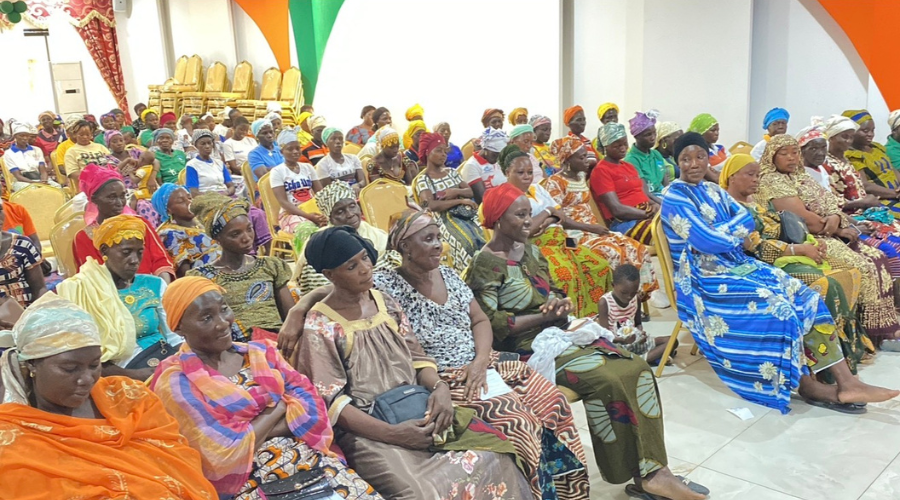
On that day, 150 Mandé-Dyula widows gathered in the city’s mayoral conference room. Our team shared food kits with each of them, but more importantly, we shared the message of God’s love.
The theme of our conversation revolved around “mère comme repère de Dieu/ mother as landmark of God.” After a word of welcome from a male authority figure in the community, we introduced our presentation by asking a two-fold question: “What are the main characteristics of a Mother and how are they related to the nature of God?”
Several prompted answers emerged from the audience, pointing to characteristics such as a mother’s unconditional love for her children, a mother who carries and gives life, a mother’s care for her children, a mother’s keenness to forgive and a mother’s resilience in suffering, etc.
Being mindful of the audience’s religious (Islamic) background, we first referred to Mary, mother of Jesus (Maryam, umm-al Isa), emphasizing her deep devotion to God, her purity and her status as a righteous woman in Islam. This choice was intentionally made, knowing that Mary/Maryam is the only woman/mother mentioned by name in the entire Qur’an and an entire surah is dedicated to her (surat al maryam/number 19). A few verses (ayats) were quoted to describe how Mary (Maryam) loved Jesus (affectionately called by Muslims as Isa ibn Maryam), how she cared for him and even protected him from people who threatened her because of his birth (Surah An-Nisa 4:156; Surah Maryam 19:17, 27-28, 29-33).
Speaking in Dyula, their native language, we used Scripture to describe God’s comforting, nurturing and tender nature—like that of a loving mother. Passages such as Isaiah 49:15, Isaiah 66:13, Hosea 11:4 and 1 John 4:8 painted a picture of a God who deeply cares for his children. We concluded that God is love (even though the Qur’an does not portray him as such), and that a mother is his landmark.
From Food Kits to Leadership Training
The room was filled with a sense of hope and connection. The impact of this event rippled far beyond what we could have imagined. News of the food distribution spread quickly throughout the community, even reaching local government officials. Inspired by what they heard, city leaders contacted us and requested similar activities for men. This unexpected response opened new doors for ministry in this restricted region.
As a result, we launched a 12-month leadership training program for Mandé-Dyula men, regardless of their religious background. This program is now equipping men in the community with tools for leadership and growth.
This story is a testament to God’s love and generosity. As John 3:16 reminds us, God’s love for the world is inseparable from His generosity to the world. Through something as simple as food kits, God made a way for His message to reach the unreached Mandé-Dyula people. What began as a Mother’s Day event for widows has grown into a ministry breakthrough, opening hearts and paving the way for ongoing discipleship and leadership development.