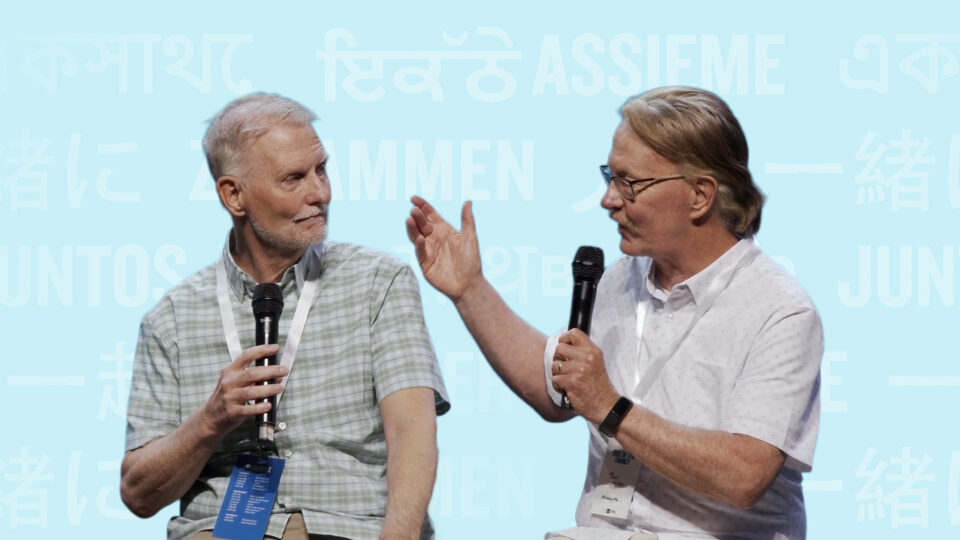
Pastor John K Jenkins, Sr.
So glad that you’re out this evening. You’re here tonight to hear a tremendous preacher who has had an impact around the world. How many of you have been blessed by the ministry of Dr. Tony Evans?
Watch this video.
Narrator
Dr. Tony Evans is one of the country’s most respected leaders in evangelical circles. He’s a pastor, best-selling author, and frequent speaker at Bible conferences and seminars throughout the nation. Dr. Evans has served as the founding pastor of Oak Cliff Bible Fellowship for over 40 years, witnessing its growth from 10 people in 1976 to now over 10,000 congregants with over 100 ministries. Dr. Evans also serves as president of The Urban Alternative, a national ministry that seeks to restore hope and transform lives through the proclamation and application of the word of God. His daily radio program, The Alternative of Dr. Tony Evans, broadcast to millions of active listeners across hundreds of radio stations and digital outlets across the nation and around the world. Dr. Evans holds the honor of writing and publishing the first full Bible commentary and study Bible by an African American. The study Bible and commentary went on to sell more than 225,000 copies in the first year. Dr. Evans is currently married to Carla Evans, the couple wed in November of 2023. Please stand and welcome Dr. Tony Evans.
Dr. Tony Evans
Good evening. May be seated. Thank you so much for the privilege and the opportunity to be at this magnificent conference, to my good friend, precious friend, John Jenkins, and his lovely wife who we have known and loved for many, many years, your president of Converge. On behalf of my wife Carla and myself, we are honored to be here. And I have been privileged over this last year through my conversations with President Jenkins to become more acquainted with Converge and what it is and what it represents and how it is seeking to do kingdom business for the glory of God and for the impact in the lives of people. And I have been impressed with what I have come to know, understand, and experience. And I have riveted a number of questions to him to find out more. And so to be part of your gathering is indeed a privilege and an honor.
To follow my daughter Priscilla—is a privilege and an honor. I didn’t know that you would wanna hear me after you heard her, but I am so delighted to be able to be with you and to be able to be part of this great, great, great ministry.
I was born and raised in Baltimore, Maryland, just down the road from here. And whether it was an elementary school, at Alexander Hamilton Elementary School, or whether it was at Garrison Junior High School, or whether it was at Douglas High School in Baltimore, every morning, the class was told to stand and to put their hands over their heart, and as many of you experienced, give the Pledge of Allegiance. Pledge allegiance to the flag of the United States of America, to the republic for which it stands. It’s one nation under God, indivisible, liberty and justice for all. And every single day, we had to pledge allegiance to our nation. It was a daily reminder of our national identity. It was a daily reminder of our national commitment. It was a unifying time for us to declare in the class and rehearse in our minds where we belonged.
Christians have an identity, I call it a kingdom identity, a pledge of allegiance, if you will, to a king and a kingdom to which we belong. The problem is when you forget your identity and you don’t know where you belong. And so the whole point of this conference and what you represent is to bring people into the kingdom and then to make their entrance their new point of reference.
Jesus called a conference when he rose from the dead. In that period of 40 days between his resurrection and ascension, he called his conferees together to give them their assignment in light of his upcoming ascension, to tell them what their duty would be when he left them. He called this conference and invited three groups of conferees to his conference.
We’re told in Matthew 28 that the disciples, verse 16, were invited to meet him on the mountain that he had designated in Galilee. So the first group of conferees that were invited to the conference were the 11 disciples, that is, minus Judas, to meet him when he rose from the dead.
A second group of conferees were invited to his conference, they are given to us in 1 Corinthians 15 when Jesus met with more than 500 brethren, it says, at the place where Jesus had designated. So that gives us about 511 or 489, just depending on how you do the math with the 11 and the 500, but these are all gathered in one place at one time for the conference.
There is a third group of conferees invited to the conference. Because when the conference concludes, Jesus concludes with the statement, “And lo, I am with you always, even until the end of the age.” Well, the age has not yet ended, so you and I have been invited to the conference. So since we have been invited to the conference with the 11 and with the 500, why don’t we all mosey on up the hill to find out what the conference was all about, since we’ve been invited?
The conference begins with worship because we’re told, “When they saw him,” verse 17, “they worshiped him.” Worship is the recognition of God for who he is, what he has done, and what we are trusting him to do. Sometimes it comes in celebration, other times in meditation, always with anticipation, but it is a recognition of God for who he is, what he has done, and what we are trusting him to do. And so when they gathered, they gathered with worship. But we’re given a tagline at the end of verse 17. It says that while they all came to worship, some were doubtful, some came with question marks, some came with challenges, but at least their doubts didn’t keep them home, their doubts brought them out. And so even with their question marks, they worshiped.
And I’m sure in the many ministries that are represented with Converge as these converge together, some come with worship and few questions, others come with worship and some questions, still others come with worship and many questions, but you’ve come. Your worship didn’t keep you away, your worship brought you out. And so the conferees have all gathered.
After the worship, after the praise and the songs and the celebration and the prayers were concluded, it was time for the pulpiteer to mount the pulpit. Jesus Christ, the centerpiece of the gathering, the inviter to the converging of these various groups, takes the podium. When he takes the podium, he opens up the introduction of his sermon with a profound statement, “All authority belongs to me in heaven and on earth.” That is, the translation is, I’m in charge now. All authority belongs to me in heaven and on earth, in eternity and in history, in the sweet by and by and the nasty here and now. I’m in charge now.
Now, there are a number of words that Jesus could have used to express his point. The dominant word in the New Testament to speak of power and authority is the Greek word dunamis where we get our English word dynamite from, which has to do with that explosive power. When we use the word dunamis, it’s the expression of might. But that’s not the Greek word that Jesus uses here, he uses another word, exousia. Exousia is a little different than dunamis. When Jesus says, “All authority belongs to me, all exousia belongs to me,” that is power in authorized hands, it has to do with the authorization of use. A criminal can have a gun, a policeman having a gun, but only one has a badge. It has to do with what is authorized. In other words, what Jesus is saying is, I am the only legitimate authorizer of power between heaven and earth, between time and eternity. I am the link between the two. I’m in charge now.
I’ve often said, in football, you have 22 men on the field at any given time, 11 men on one side, 11 men on the other side, they’re young, strong, and fast. You have seven officials, they’re old, slow, and fat. The players can knock you down, but the refs can put you out, ’cause the players have dunamis, but the refs have exousia, they got a yellow flag and a whistle, they have authority.
Jesus says, “I’m in charge now.” I am the one who is calling the shots. I am the one to whom your allegiance is to be given because I am the one who can give you authorization. I am the one who can, okay, binding, or loosing, deny what you are about. I am the one who can give you success or block your efforts. I’m in charge now. And I’m not only in charge in certain areas, all authority has been given to me so there is no category to which my authority is not to be applied. I am to be brought in to every scenario, every circumstance, every situation that you are dealing with because I’m in charge now and I’m in charge of all of it. All authority, all authorization belongs to me.
Having introduced his person and his position, that leads him to the body of his sermon. The body of his sermon is surrounded with three participles that are designed to infuse one imperative. There’s only one command that he makes, but that command is surrounded by three participles, and whenever you have that construct in the Greek text, the participles are designed to give you the methodology for achieving the imperative. An imperative is a command, it is something that you must do. A participle or the three participles are the processes that are designed to equip you to achieve the imperative. So what he is saying is, I’ve got one thing I want you to do and three things that will make you successful in getting it done.
And that becomes the body of what is known as the Great Commission. There are five commissions in the New Testament, Matthew, Mark, Luke, John, and Acts, each one of them has a commissioning by the risen Christ. But we only call Matthew the Great Commission because it is the only one who uses this particular imperative, and it is make disciples. He says, “I want you to converge together to hear my instruction and it is singular in its demand, I want you to make disciples.”
Now, the Greek word for disciple is mathetes. Mathetes is not a Christian word, in other words, it was not a word Jesus created or came up with, it was part of the everyday vernacular of the Greco-Roman world. If you were living during this time, you would regularly hear this word used in the discussion of life among the people. It finds its root going all the way back to Plato. Plato developed a philosophy of life where he separated the physical from the metaphysical, where he separated the body and the spirit and created two different identities. You and I have that today when we talk about secular and sacred. That is a Platonic thought that there is this spiritual realm and there is this non-spiritual realm, secular and sacred, that is, the Platonic thought in contemporary vernacular of this way of thinking and this identifying in the world in which we live.
He had a student, who took up his philosophy, named Aristotle. Aristotle took the thinking of Plato and he systematized it, organized it, and arranged it into a system of thought, we call that Aristotelian logic, that is, the logical thinking of Platonic thought in the system established by Plato. When Aristotle developed his system, he built schools and he called these schools academies. That’s where we get the word when you come across a Christian school today and they call it academy, it goes all the way back to Aristotle building his school that had the systemizing of Plato’s thinking in the organizational structure of Aristotle’s thoughts. And so when students went to the school, they learned the thinking of Plato through the system of Aristotle. When they graduated, they graduated into the Greco-Roman world. They graduated as doctors and lawyers. They graduated as scientists. They graduated as engineers in their day. They graduated with all of these skills, but with this identity that they’d gotten from Plato through Aristotle. And these graduating students were called disciples.
Disciples, the term that Jesus borrows to use for his converged conference, he gets that word and he places it in his purpose, and he says, “I want you to make disciples. I want you to make a generation of people who take the thinking of heaven and bring it down to earth. I want you to develop a group of people who take the worldview of this king and his kingdom and exercise it into history. I want you to train a group of people in the thinking of eternity so that they are executing it in time, and I want you to call these people disciples.”
A disciple is a visible, verbal, full-time follower of Christ. A disciple is a visible, verbal, full-time follower of Christ. Christ and their relationship to him becomes their identity. In other words, because they’re operating out of a philosophy, a worldview, that is derived from heaven, introduced to earth, linked between the two by Jesus Christ. He says, “I want you to make disciples. I want you to create a group of people who have developed my way of thinking in the world in which they live. And so in what you do, in the planting of churches and the spreading of missions, is to bring people into a different way of thinking that is derived from heaven and executed in history, and I want you to make disciples.”
When you come to a conference, you come for information, you come for gathering, you come for challenge, you come for execution. Conferences are good times to gather, to get reinvigorated, reconnected together, around your mission statement, around your purpose, around your goal. Conferences don’t accomplish the task, conferences give you the basis foundation and information for when the conference is over to execute the task.
Conferences are like a huddle in a football game. 100,000 people don’t gather in a stadium to watch 11 men bend over, they don’t gather to watch a huddle, they gather to see what difference the huddle makes, they gather to see, having had your private conversation, can you perform in your public execution? In other words, they gather to see what difference the huddle makes. The greatness of your Converge conference is not in your gathering, it’s in your influence and in your impact. Because if you have a huddle, but you can’t score, then you had a conversation that’s made no difference. But if you have a huddle and now you’re getting first downs and touchdowns, now the huddle, the conference, mattered because it made a difference on the field of play, it influenced history.
He says, “What I want you to do is I want you to make disciples. I want you to make visible, verbal representatives of me.” But then he makes an additional statement that doesn’t get a lot of attention. I’ll take just a moment to reference it, because when we tend to talk about discipleship, we tend to talk about it on an individualistic level. In other words, I disciple this person, this person disciples that person, and certainly that is a part of the process. But if you look at Jesus’s statement intimately, he says, “What I want you to do is disciple the nations,” the ethnos, the Greek term is. “I want you to disciple the nations.” In other words, I want there to be national implications of your discipleship program. And while that involves, obviously, individuals and families, I want the nation to have to deal with what you introduced to them. I want your vision to be so big that the nations have to deal with this influx of disciples.
When Aristotle had the people graduate from his schools and they entered the Roman military machine that controlled the world at that time, Rome ran into a problem. In your history classes, they called it the Hellenization of Rome. Rome was the military power, but Greece was controlling the culture because of this influx of disciples into the Roman world. And Rome, that’s why it’s called the Greco-Roman world, it had been Hellenized, that is, military power of Rome, but the culture of Greece. God says, “I want you to make followers of me and I want the nations to be influenced by the disciples that you develop who enter the world with this new worldview.”
The greatness of Converge in your converging together. And I love to hear what I heard briefly today about the scope and the spread and the influence, not only nationally, but now internationally so that folks have to deal with Jesus wherever Converge folks or churches show up. Because it has implications. One of the problems in our nation is that the implications of the gospel has not spread to bring cultural shifts because we’ve been satisfied to keep it in the huddle rather than take it on the field of execution. He says, “I want you to make disciples, and I want there to be a national repercussion derived from it.” That’s why when he gave the commission in Acts, he says, “You’ll be my witnesses in Jerusalem, Judea, Samaria.” He gives this national scope to the mission, which is the scope of Converge. So the goal is to make visible, verbal followers of Christ whose scope of impact nations have to deal with. That is his imperative, that is his command, that is his demand.
He then gives three participles. He says, “Go.” That’s the first participle, go. Now, you can study the word go in Hebrew, Greek, Ugaritic, Syriac, go means go. Go means don’t stay. Go means that there is to be a public presentation of who I am through my representatives. Everybody else is coming out the closet, we might as well come out too. This is not a day for secret agent Christians, spiritual CIA representatives, and covert operatives.
9/11 is a day that will live in infamy in America. 19 men from halfway around the world on September 11th, 2001, came to the most powerful nation in the history of mankind and brought us to our knees. You will never travel again like you traveled before 9/11 because the threat of terrorism has forever changed how you travel from here to forever, because 19 men, in the name of their God, left halfway around the world, came here, boarded planes, and forever changed how we operate. So if 19 men in the name of the wrong God can shift how a nation operates, what do you think Converge could do in the name of the true God in affecting the atmosphere?
He says, “I want you to go. We’re not going to live in the conference. We got this conference going on to the 511 who were there, but we’re not gonna live here, we’re gonna give a benediction and then I want you to go.” And as the Book of Acts teaches us, if you refuse to go, Acts 8, I’m’a call a disturbance to make you go. ‘Cause I don’t want you to stay, I want you to spread.
So the first participle is to go. This Greek word go is used in Matthew 10 when Jesus tells his disciples to go to the lost sheep of the house of Israel and tell them the Messiah has come, that is, evangelism. Evangelism is how people enter the kingdom. That’s the good news of the gospel of the death and resurrection of Jesus Christ for the forgiveness of sins and the free gift of eternal life. That is, that is, how you enter the door of discipleship is through the good news of the gospel. He says, “I want you to go and let them know I have risen, I am alive, and I save.”
Then the second participle is then I want you to baptize them. Baptize them. I want you to baptize them in the name of the Father, the Son, and the Holy Spirit. The Greek word baptizo was a very interesting word in New Testament days. A mother who wanted to make her daughter a pink dress would take the cloth to the local dye maker. So if the cloth was gray, but she wanted to make her daughter a pink dress, she would take the cloth to the dye maker and say, “I would like this cloth dyed pink.” The dye maker would mix his dye, take the cloth and immerse it in the dye, removing extraneous dye, hang it up and let it dry. The gray cloth is now pink because it had been baptized. It had been put down in the dye and the color changed. There was a new visible identity difference. That’s why when Paul speaks of baptism in Romans 6, he tells us that we were buried with him in baptism and raised to the newness of life. He tells us that there is a new look in the same person. It was the same cloth, it just had a new look because it had been baptized so she could now go make her daughter a pink dress because there was a new identity, and there was an identity in the name.
Names are important in the Bible, names are not merely nomenclature. There’s some 85 names of God in the Old Testament alone, each one of those names is designed to give you some new characteristic of God. The inexhaustible God lets us know aspects of his person by the various names he uses. And so he’ll go from Elohim to Yahweh to Adonai to Jehovah Jireh, Jehovah Shalom, you know, and he goes. So he gives these names, and these names are very interesting because these names are given in the scenarios of life or history. In other words, he’s showing you something about himself when he tells you something about his name. His name is an information center about his identity and his person. He says, “I want you, after you’ve gone and you shared the good news, to immerse them in an identity.” So baptism is designed to shape an identity.
That’s why Paul has to correct Peter in Galatians 2 because he forgot his identity and he has to quote to him, Galatians 2:20, “I’m crucified with Christ, nevertheless I live, yet not I. It’s Christ who lives in me, the life I now live, I live by the faith of the Son of God who loved me and gave himself for me.” We love to quote that verse, oftentimes we forget that verse is not in abstraction, Paul is quoting that verse to Peter because Peter forgot who he was.
One of the things that Pastor Jenkins told me that he loved about Converge was its diversity and that you’ve decided being Christian doesn’t deny your humanity, but it does define it. And so he says, “I want you to baptize him in the name.”
In the video, it was cited that my wife Carla, we were married in November 11th, 2023. I lost my wife, as most of you know, in December 2019. She and her husband were on their way to my wife’s funeral when he died of a heart attack. Some years later, we bumped into each other at an event and these circumstances took place, we were married. When we were married, she changed her name, her last name changed and she took my name. But she didn’t just take the nomenclature, it involved the nomenclature, but a whole series of events began to be introduced. She relocated. Documents were changed. How she’s referred to changed. How people interacted with her changed. There were adjustments that had to change because the name wasn’t just a word, it was a new association.
When we’re discipling people, we’re giving them a new name, we’re giving them a new association so that they’re not to be referred to as though they did not enter into a different relationship, that they have become identified. Baptism is a new identity, and that is a part and parcel of their discipleship. And he says, “This new identity, baptize them in the name. We want them to be trinitized,” because he says, “Baptize them in the name,” singular, “of three pronouns, the Father, Son, and Holy Spirit.” That’s the Trinity. Now, technically, you should say names, plural, if you have three pronouns unless these three are one. You baptize them in the name, singular, of the Father, the Son, and the Holy Spirit, you trinitize ’em.
What does that mean? That means this is their new identity. So a doctor is not just a doctor, he’s God’s representative in the medical field so the medical field sees what God looks like when God helps hurting people. A lawyer is not just a lawyer, he’s God’s representative in the Bar Association so the Bar Association sees what God looks like when God tries a case. A teacher is not just a teacher, he’s God’s representative in the educational field so the educational field sees what God looks like when God teaches a lesson. In other words, they become identified in who they are and what they do because they wear the name, bear the name, and share the name. They’re unapologetically Christian.
So he says, “I want you to baptize them, I want you to give them my ID.” And unfortunately today, we have too many Christians with fake IDs. They don’t wanna be identified, except on Sunday. Says, “I want you to baptize them, and then I want you to teach them.”
There’s a third participle. Well, what are we gonna teach them? Pneumatology, ecclesiology, eschatology, angelology, hamartiology, anthropology, what are we gonna teach them? To become biblically astute, to become dispensationally oriented? What exactly are we going to teach them? Says, “I want you to teach them to observe whatever I have commanded you.” He says, “I want you to teach them observation based on information, not information apart from observation.” They need information, whatever I’ve commanded you, but the goal of the information is observation, or as we would say, application. I want you to show them how to understand biblical truth in such a way that they use it and not just quote it. I want this to be inculcated into their worldview. I want them to be the new way that they operate in the society, in the nations, in the culture. They operate different because they’ve been informed differently, because they’ve been taught differently. They’ve been taught whatever I’ve commanded you.
Let’s say you’re gonna have heart surgery and it’s life or death surgery. The surgeon comes in. “We’re gonna operate on your heart tomorrow. Let me tell you what we’re gonna do.” He goes through all the idiosyncratic elements of the operation in detail. “You could live or die, but this is what we’re gonna do. Do you have any questions?” You say, “Yes. How many times have you performed this surgery?” The doctor says, “Well, you’re my first. But don’t worry, I made all As in heart transplant class, so my grades validate and verify that I am more than able to get you through this.” Well, if I were the patient, I’d have two questions. One, how many times have you done it? First question. Second question is, how are them people doing? Because if none of them made it, I don’t care how many times you did it, I’m not gonna be your next patient. In other words, you don’t just want information, you want skill, you want to know there’s been usefulness with the information.
One of the great benefits of a bibliocentric gathering is that you get the right information, but more importantly is the right execution. So he says, “I want you to teach them whatever I have commanded you ’cause I’m in charge.” I don’t first wanna know what the culture says. I don’t first wanna know what the secular world says. It’s fine for you to know it so you can evaluate it by me. I don’t want you to get your information on race and politics and economics and all of that apart from me. I want to infuse my thinking into all subject matter. I do not want a distinction between secular and sacred ’cause I’m in charge of heaven and earth, making everything sacred.
So he’s given us an introduction, “I’m in charge.” He’s given us a command, “Make disciples.” He’s given us methodology, “Go evangelize, then get them identified, then instruct them in application of the truth.” Then he concludes his sermon. He says, “And lo, I am with you always, even until the end of the age. And lo, I am with you always, even until the end of the age.”
In the Greek text, we call this an ego eimi construction. Ego eimi is translated I, even I. The word I is written twice. It’s called ego eimi, I, even I. In your versions, they don’t write it like that, they don’t write the word I twice. What they do is intensify the one use of the I, which is why in your versions, like in the King James, you read, “And lo, I.” Shown-off me. They intensify the one I rather than writing the word I twice. So, “And lo, I,” shown-off me, “will be with you always, even until the end of the age.”
Why would he write his name twice? Well, remember in verse 19 he says, “Baptize them in the name of the Father, the Son, the Holy Spirit.” Well, that’s the whole Trinity. But when he comes to verse 20, he leaves the Father out, he leaves the Spirit out, and he says, “And I, even I,” me. Why did you leave Daddy out and why you leave the Spirit out? ‘Cause I’m in charge now, all authority’s been handed over to me. So my Father’s not going to do anything unless it agrees with me. The Holy Spirit’s not going to do anything unless it agrees with me. So you better be straight with me if you wanna hear from him and the power of the Spirit over here. You got to deal with me. I am the key, I am the link between time and eternity, which means that Jesus did not deal with all of us equally.
For example, in St. John 2:23-25, it says, “Many believed in him.” The Greek phrase is pisteuo eis, which in John always means got converted. “Many believed in him,” and then it says, “but he would not commit himself to them for he knew what was in them.” Many got saved, but he wouldn’t commit himself to them because they were not all in yet. They were on their way to heaven, they were not any good for earth yet. That’s why discipleship has to be our goal because you want them to get converted so that they go to heaven, but you want them to be disciples so that they’re useful in history.
And so he says, “And lo, I will be with you always, even until the end of the age.” Well, the age has not ended. So you have converged together for the purpose of being infused, encouraged, ignited for the benefit of the nations, to make replicas of Christ for influence in the culture. And you will be known not primarily for your name or your look or your program.
A bowler is known for one thing, impact. How many pins did you knock down? ‘Cause no matter how good you look, if them pins are still standing, you’re just a good-looking failure—’cause it’s about impact.
So I celebrate you, I celebrate what I have learned about you. I’m celebrating about the leadership you have for you. I’m honored and humbled that I was included to be with you. And as you make this dent for the glory of God, many people will be in heaven and there will be greater impact on earth because you did converge and you met with Jesus on top of the mountain.
In closing, you know, in movies, they will show you if you go to a movie, before the movie that you go to begins, they show you previews of coming attractions, those are clips of the upcoming movie. The clips are always engaging, fight scene, love scene, chase scene, and they string them all together to give you one exciting thing after another because they want you to come to the movie, so they show you these exciting clips.
One day, there’s a big show coming to town. God is the producer, the Holy Spirit is the director, Jesus is the superstar, and it will be a worldwide production. It’s called the Kingdom of God. But in the meantime, he’s left you and me here to create previews of coming attractions. See, we’re supposed to be the hot clips of the upcoming show. So that when people see the hot clips of your impact, of your birthing churches, of your influence in the culture, they get these hot clips of the upcoming show, and when they see the hot clips of the upcoming show and they raise the question, “Where can I buy a ticket to the whole show?” of course that’s when you can tell them, “You don’t have to buy a ticket, the price has already been paid.”