

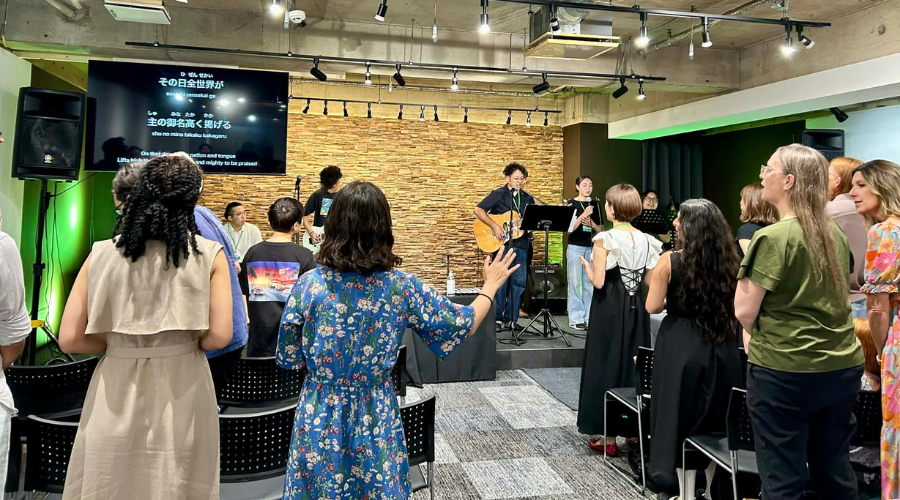
Brit Redfield has seen it: God’s mind-blowing long game.
Brit first set foot in Japan on a short-term trip with fellow seminarians. They ventured onto Japanese college campuses, struck up conversation and—naturally explained, as visiting students of religion—shared the gospel.
In contrast with her own childhood in the Bible belt, when Brit shares the gospel with a Japanese person, it’s almost always “the very first time. They grew up their entire life without [much] religion.”
Here, Christianity is viewed as foreign, Western. The hearer has “no concept of a Creator God.” But this Long-Game God is “going after his sheep [Luke 15]. Sometimes faith comes quickly. Sometimes it can take a while. We just share the gospel faithfully. God will bring the growth, the gospel movement.”
Building Trust and Planting Seeds
Brit was assigned a Japanese woman as her tutor for eight lessons. “I tried to share the gospel. She wasn’t interested.” It was tough to wait on God’s timing. “I want them to come to Jesus today!” But Brit’s training had sensitized her to this body language of disinterest; she returned to the trust-building of friendship.
Before moving away, Brit gave her tutor a Bible. They stayed in touch, and Brit continued to pray for her. When Brit eventually returned, her tutor accepted her invitation to church. Brit observed from afar as her tutor became friends with another missionary, and the tutor’s son expressed interest in Christianity.
Brit asked, “Would you like to learn more about the Bible?”
The tutor’s response? “If you do it in Japanese.”
For an English speaker, mastering Japanese takes 2200-4400 hours (compared to 600-1200 for Spanish). But when Brit moved to Tokyo as part of Converge’s Japan Initiative, she asked her tutor for lessons.
At first, talking about the Bible was “way too hard for my baby Japanese,” Brit laughs.
But according to Brit, the teacher eventually said, “‘You went to seminary. You had to write papers! I’m going to give you questions about Christianity’—like What does the Bible have to do with my Japanese life? What does success look like?—a very Japanese perspective. She wanted to learn, and knew that I wanted to tell it to her.”
The tutor now plans to fly from her city to attend church with Brit.
“Even when I wasn’t there, God was still working,” Brit said
A Nation at a Tipping Point
And the Japanese Church acts as its own apologetic. Like any culture, Japan experiences its own brokenness—often intense loneliness and overwork (to the point of having a word, karoshi, for death by overwork). Brit perceives the nation at a tipping point, fighting a lagging economy, low birth rate inadequate to replace their workforce, immigration, high cost of living and tremendous isolation.
“They’re trying to maintain an image that they have it all together,” she said.
Brit cites the Japanese concept of ganbaru (頑張る; “stand firm”), which Wikipedia roughly translates “to slog on tenaciously…in practice, it means doing more than one’s best.”
And yet the Japanese are “at a place where they can’t pull themselves up by their bootstraps any longer,” according to Brit. Yet “culturally, they rarely accept welfare or share problems with anyone; this is to become someone’s burden.
“But in Christianity, we ‘Bear each other’s burdens’ [Galatians 6:2],” she said. As culture strains beneath independence and hopelessness, the Church offers “hope, love, community—meeting a deep need they have when nothing else has worked.”
A new church attender might be startled by the community and safe space they’ve longed for.
Brit recalls sharing the gospel with Fusako.
“She opened up to me about her overwhelming new job out of college,” Brit said. “She didn’t want to burden her parents and closest friends,” which meant she could turn to no one.
Fusako was overcome by Brit’s assertion that “There’s a God who loves you. You can access him anytime.”
Another student, Aki, showed up at a church party before Brit returned to the U.S. Aki was puzzled.
“How are you guys so kind?” Aki asked. “Why are you doing this?”
The team’s response—We love you. God loves you, and counter-culturally, there’s no catch—caused Aki to connect with the church. Later, she was baptized.
Scattering Seeds in a Missionary Graveyard
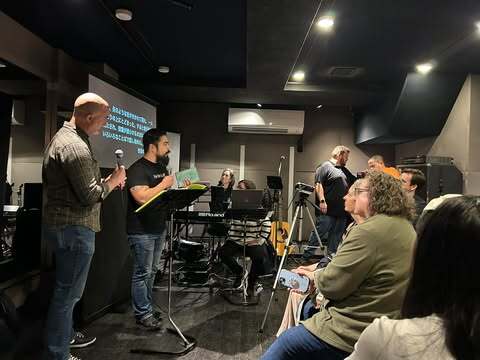
Amid church decline, the Japan Initiative’s Tokyo team plants churches along Tokyo’s Seibu Ikebukuro train line, which feeds several cities. Converge comes alongside local churches evangelistic in culture, passionate to reach their community—to strengthen, equip and empower church planting.
This train line provides critical access to churches in a country with roughly one Protestant church for every 16,000 people. Across Japan, nearly 1800 towns, villages and neighborhoods are still waiting for their first church. With about 123 million people, Japan remains the second largest unreached people group in the world, with one missionary for every 60,000 people.
In comparison, Japan has one vending machine for every 23 people. So “we want to make churches as common as vending machines,” Brit said. “Gospel access is so limited!”
As far back as the 17th century, Japan acquired the tragic reputation of a “missionary graveyard”—starting when, during the Tokugawa shogunate, Christian missionaries were expelled or executed, leading to the near-extinguishment of the faith for over 250 years. A convert’s commitment to the stark minority of Christianity requires a leap.
“To be Japanese is to fit in,” Brit said.
Or, as one Japanese proverb expresses, “The nail that sticks out will get hammered down.”
But as team member Ariel Lee coached Brit, “We don’t worry about whether people are hard or soft. We just share the gospel in love. God will grant the victory. If you don’t think God will grant the victory, you shouldn’t come over here.”
Brit’s short-term teams maintained statistics on their evangelism trends and found them strikingly similar to those of sharing faith stateside.
“If we spend our time watering one seed, we’re going to be discouraged. But if you scatter [broadly]…”
She shrugs.
“Even if there are those discouragements, I don’t have time for them. We’re too busy with those who are interested.”
“The harvest is plentiful, but the laborers are few.” – Matthew 9:37