

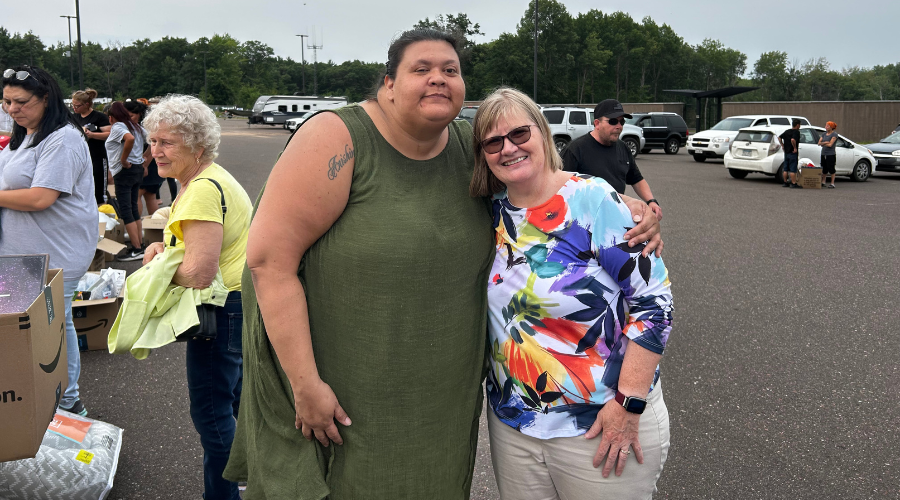
When Martha Anderson retired as an elementary school principal, other retiring staff eagerly shared their retirement visions of book clubs and flower gardens.
But Martha? Martha, of Converge’s First Baptist of Webster, Wisconsin, was going…to jail.
Twenty years before, God had stirred Martha’s heart—and changed her life—through a one-dollar book at a garage sale, detailing the path of a convict as he returned to Christ in prison. The book gave Martha a peek into the power of prison ministry for transformation, which, in retirement, she hoped to leverage in full.
At the beginning, in the late 90s, Martha and a few friends began meeting with 40 men at Sandstone Federal Penitentiary. Most had first encountered Jesus in the county jail. Martha realized she wanted to be the first one to tell people about Jesus.
So at a school basketball game, Martha sat next to Jonathan Mosher, a fellow Converge church member, and county jailer known for kindness to inmates. “Is there a way for me to do a Bible study at the jail?” she asked.
Jonathan said they had neither the space nor the programming in their small jail. But Martha knew that if God wanted her there, this ministry would happen.
“Keep me in mind,” she told Jonathan.
“My People Can’t Read a Bible”
One morning, his wife called Martha after Jonathan arrived home from his night shift. “Does your offer still stand?” She asked if Martha would meet with an Ojibwe woman (from an Indigenous people group) on suicide watch.
Jonathan had asked the woman if he could give her a Bible, and she replied, “Oh no, my people can’t read a Bible.” He then asked if she would talk to a friend of his, and she agreed.
Many Natives are raised to hate Christianity due to the vast atrocities committed against Native peoples, including several generations taken from their homes into 526 residential schools, half run by the Church. In the schools, these 150,000 children were habitually neglected, starved and verbally, physically and sexually abused. Hundreds died. Many committed suicide.
Perched on a concrete bench in the jail’s austere lobby, waiting to meet this young woman during visiting hours, Martha felt a sense of powerlessness. An elevator took her to a small lobby with three phones above corresponding steel stools for visitors.
The woman entered, sitting on the other side of double plate-glass windows. No dividers offered conversational privacy. It became clear she didn’t want Martha to say anything about Jesus or her situation; either topic could be heard and later scorned.
A second visit yielded a similar result. In this environment, how could they share a real conversation?
At Martha’s insistence, Jonathan arranged for a small room where typically lawyers met with inmates. In the first meeting, Martha shared the good news of Jesus. The next week, the Native woman “invited everybody in her cell—all Ojibwe. She was telling everybody she’s following the Jesus way.”
It’s how Martha began leading Bible studies at Burnett County Jail every Sunday. With a veritable revolving door of female inmates, she leaned toward more evangelistic messages—the woman at the well (John 4), the woman pressing through the crowd, desperate to touch Jesus (Luke 8:43-48).
It was a study that would continue for 20 years. Martha met with all the women who would attend.
Bigger Jail, More Opportunity
Yet as it did for the rest of the world, COVID closed jails to outsiders. Martha began to pray, “God, lead me to hungry hearts.”
Only a week later, another county’s jail program director called, having glimpsed Bible studies Martha had written and mailed to another inmate. She asked if Martha could send studies for two women.
Martha drove them to the jail, expecting a simple delivery. At the handoff, the jailer asked if Martha would meet with the women as well. By 9 a.m. the following day, Martha was back behind glass partitions, sharing about Jesus and the way of salvation.
Once COVID restrictions lifted, Martha was once again able to conduct minimum- and maximum-security groups with women incarcerated for months at a time—opening beautiful doors to longer-term discipleship and lasting life change.
Eventually, groups reopened in Burnett County once again—this time, with men and women. When the tiny jail finally constructed an addition in the fall of 2024, more counties sent inmates for longer periods of time.
“Build a bigger jail, more people get to hear the gospel,” Martha reasons.
With inmates now able to attend for months, Martha leads studies through Mark, John and Romans. When inmates are sentenced to prison, she corresponds by mail and sends Bible studies. Upon their release, she helps navigate the often rocky path that is life outside, where friends, family, addiction, lifestyles and destructive patterns threaten to swiftly suck these new disciples back into old ways.
Yet perhaps like Jesus’ experience on earth, among inmates Martha has found an inspiring level of desperation for Him.
“Most Christians,”—unlike prisoners—”don’t have that same destitution like that woman in the crowd,” Martha reasons. “It’s exciting to watch!”
A Different Kind of Retirement “Garden”
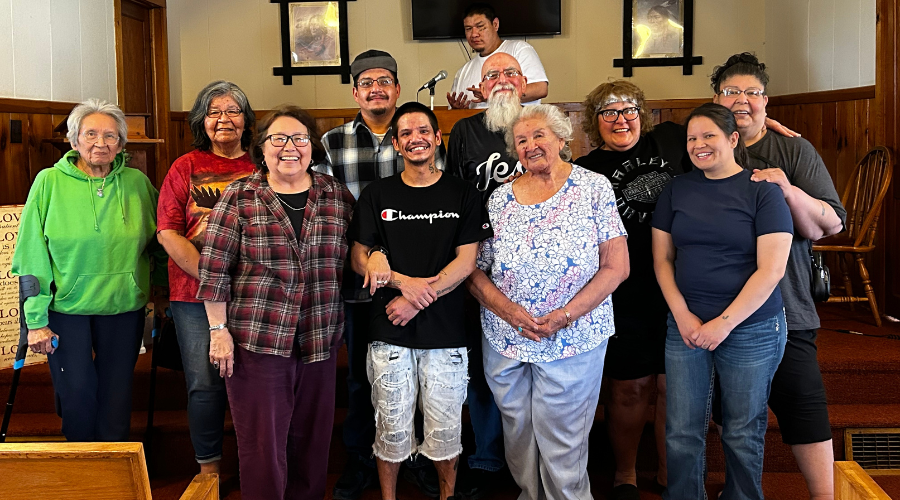
And God has cultivated several success stories, like Martha’s valuable friendship and spiritual journey alongside Jolene, an Ojibwe woman. Released from prison and recovering from alcoholism, Jolene now holds her own Bible studies in the local jail. After regaining custody of her children, Jolene has led them to Him.
Martha met Michael in prison, too, as he worked through Alcoholics Anonymous’ Twelve Step program. During his moral inventory, she asked, “Have you ever been to church?”
“I went with my aunt two weeks before I went to jail.”
“What about Jesus?”
“Funny you should ask. I’ve been wanting to turn my life over to Him.”
Martha pressed gently. “What does that mean to you?”
He thought for a moment. “I know he’s God, came to earth, died for my sins. I’m done [with the life I’ve been living]. I want to give my life to him.”
He and Martha prayed together, then met for a month. At 16, Michael’s girlfriend had aborted their baby without asking him—triggering his lifetime of drinking. It was a wound that had lasted until his present, at age 45.
“Give that wound to God,” Martha said. “Let the blood of Jesus cover it.”
The next time they met, Michael shook his head. “I don’t know how to say this. I feel different. Fifty pounds lighter.”
Every week, Martha says, God does “something big” like this.
“A Grace-Bomb Went Off”
Katy, another prisoner, had been allowed to delay her sentencing to attend a Christian rehab program, Adult Teen Challenge. Martha met with Katy weekly for nine months through the visiting window and kept visiting throughout Katy’s time at Teen Challenge. Katy faced sentencing for a previous crime in Minnesota before finishing the year-long program, an expected 10 years in prison.
But the judge simply pointed at Katie. “You’ve changed.”
In a very unexpected move, he sent her back to finish the entire program.
“It was like a grace-bomb went off,” Katy said.
Following the program’s completion, Katy still faced a potential 10-year sentence in Wisconsin. Instead, by God’s goodness, she was given only a year — in the same jail where Martha met with her.
When given a chance for house arrest, an area church family welcomed Katie to live with them. Another from the same church hired her.
Today, Katy has married a staff member of a separate Adult Teen Challenge. Together with their young daughter, they’re moving to assume leadership of another Teen Challenge program.
Martha’s Converge congregation has been continually supportive, covering Martha’s expenses for Bibles, books and travel. A dozen church members regularly pray for inmates’ requests. Others remain penpals with female inmates in prison. Their church has baptized a former prisoner-turned-pastor.
In 25 years of jail ministry, Martha speculates mildly that she’s met with over 1000 inmates, often one at a time. She currently meets with at least 200 women per year.
They’ve come to jail, only to be set free indeed (John 8:36).