

When the underground church wants to meet, it may be time for a birthday party.
For this kind of gathering, an excuse is needed. A “birthday party” might be scheduled for 7 p.m., for which believers begin arriving at 10 a.m. Even for a few hours of meeting together, extensive precautions must be taken. Believers cannot worship loudly. Baptisms prove difficult. Only Islamic marriages are legal.
In the past year, Iran’s authoritarian theocracy prosecuted over 300 Christians in Tehran alone. The Center for Human Rights in Iran explains a recent spike in the persecution’s brutality and intensity.
“The authorities portray Christian evangelicals as a threat to the state, charging them with ‘acting against national security,’ which carries lengthy prison sentences, and apostasy, which can lead to execution.
“Promoting Christianity is criminalized as ‘propaganda against the Islamic Republic.’”
Authorities may endanger family members, construct kangaroo trials and/or leverage torture and extreme violence.
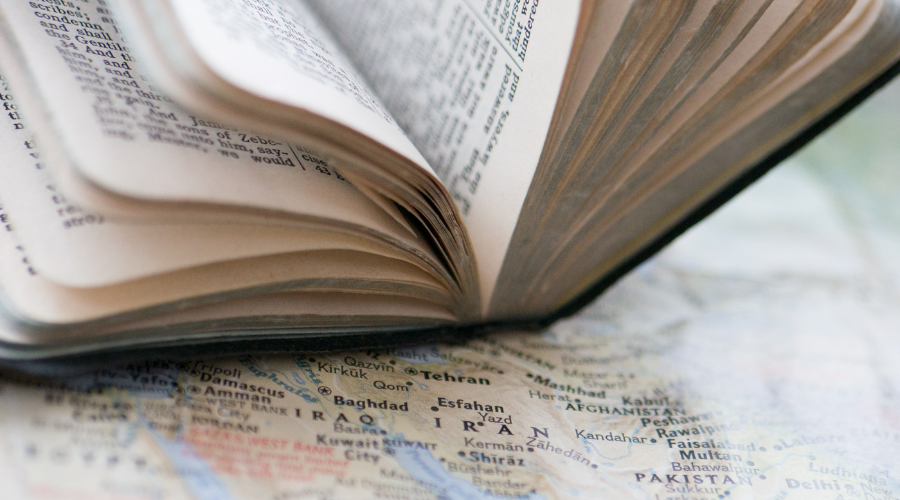
So for the average pastor, a Bible could be evidence of a crime. For each gathering, they might rip out a page of the Bible, take it with them and speak to the gathering using both sides of the page. Their contraband Bible is slowly ripped apart.
Congregations and pastors are understandably hungry for more.
“It’s cool, but sad, what a believer has to go through to worship Jesus,” said Ahmad, an Iranian living in Vancouver.
The Oasis
Ahmad spearheads a vast network of the Iranian underground church. Throughout the year at a safehouse, the network quietly gathers persecuted leaders from Iran and Afghanistan.
“Conferences become very special. Now I understand what church is. Now I can worship freely,” Ahmad reasons.
Pastors are filled, resourced, equipped and healed — returning for more gospel work in one of the world’s top-10 most dangerous nations for Christians.
In a time when cults prey on the theologically uneducated, these conferences provide vital theological and worship training, baptisms and Christian marriages, plus deep care for weary, fearful leaders. Many are recovering from intense trauma.
Despite 18 network leaders currently imprisoned, these courageous Indigenous leaders desire to bring Jesus to the most remote and rural corners of Iran, sending Indigenous missionaries to their own people. The Church also broadcasts a satellite channel reaching directly into Iranian homes, as well as a hotline for the faith-curious.
“We believe God is going to use Iran to evangelize the entire Muslim world. Christianity in Iran is growing like wildfire,” Ahmad explains. “Recently, one of the most high-ranking government officials in Iran publicly stated that the greatest threat facing the country is evangelical Christianity. They don’t know what to do because Iranians are so open to the gospel.”
The Iran God Loves—and Pursues
Ahmad refers to biblical prophecy about Elam—modern-day Iran—in Jeremiah 49:35-39, where God judges and scatters the nation. “There shall be no nation to which those driven out of Elam shall not come … But in the latter days I will restore the fortunes of Elam, declares the Lord” (vv. 36, 39).
So many Iranian conversion stories remain starkly unconventional. One caller to the network’s hotline was “a literal shepherd, illiterate, from a rural area of Iran, where the gospel has reached the least,” Ahmad recalls.
The shepherd dreamt of a white-robed man who introduced himself as Jesus Christ, glorious in a way only God could be. The figure said he had chosen the shepherd and had been looking for him—and was asking the shepherd to follow Him, stating, I am the only way, the only truth.
The shepherd awoke. What was that? Who is Jesus? I knew he was a prophet. The shepherd feared telling anyone and brushed it off.
Yet the next night, he had the same dream of the same glorious man—and again the night after that.
The next day, he asked about Jesus at a local tea shop. People looked at him with suspicion. “Are you crazy? Aren’t you a Muslim?”
Yet as he walked away, a man slipped him the hotline’s phone number.
On the hotline, Ahmad shared the gospel with him. The man accepted the Lord and is now a devoted follower. The call center sent him an audio Bible.
Ahmad points out that the network had nothing to do with this man, yet like the Ethiopian eunuch (Acts 8), God himself reached out. “I tell you, if these were silent, the very stones would cry out,” Jesus reminds us (Luke 19:40).
Despite a government straining to utterly silence Christianity, the persecuted church serves a God who opens doors no one can shut (Revelation 3:8).
How Can We Help?
- Give. Despite significant growth and impact, this Converge project remains only 1% funded, leaving many Indigenous pastors turned away from the conferences, without access to training and support. Five hundred dollars funds a persecuted leader’s entire experience, education and healing. Additional giving helps run the for-profit business that covertly hosts conferences.
- Sponsor a pastor. With a monthly donation of $25 or more, donors can sponsor the theological training and care of an Iranian church leader.
- Volunteer—and go. Partner churches travel outside Iran to directly support and teach at these critical conferences. Biblical counselors are welcome to help provide vital trauma support. Teams literally embrace the persecuted church in unprecedented unity and support.